

Previous Article
News
Research note
By Ioan Durnescu
Co-producing Desistance is a research project examining the use of social co-operative structures of employment as a mechanism for supporting the resettlement of prisoners and enabling longer term processes of desistance. This project is run by Beth Weaver at the University of Strathclyde and will run from January 2015-2018. Across the UK, and indeed further afield, increasing political, professional and public concern has been expressed about the economic, social and human costs of the increasing use of imprisonment and of reoffending following release. Consequently, there is now growing interest in developing innovative and sustainable practices that can facilitate the social integration and desistance of former prisoners. Research on why and how people stop offending (desistance) has incrementally refocused attention on the kinds of conditions and supports that variously enable or constrain social integration and desistance. However, despite the identified correlations between participation in employment and desistance, this is an area that has received limited attention in policy, practice and research. Responding to this gap in research, policy and practice, this study will examine the potential of a recent innovation in the use of social cooperatives in the UK. In particular, this research uses case studies of more established through-the-prison-gate social cooperatives in Italy to inform emerging cooperative structures of employment in the criminal justice system in the UK in order to consider what social cooperatives might contribute to the integration and desistance of former prisoners; to consider how this learning can translate into improvements for policy design and service delivery in a criminal justice context; and crucially, to inform new ways of working to support social integration and desistance.

Related News
Keep up to date with the latest developments, stories, and updates on probation from across Europe and beyond. Find relevant news and insights shaping the field today.
New
Violent Extremism
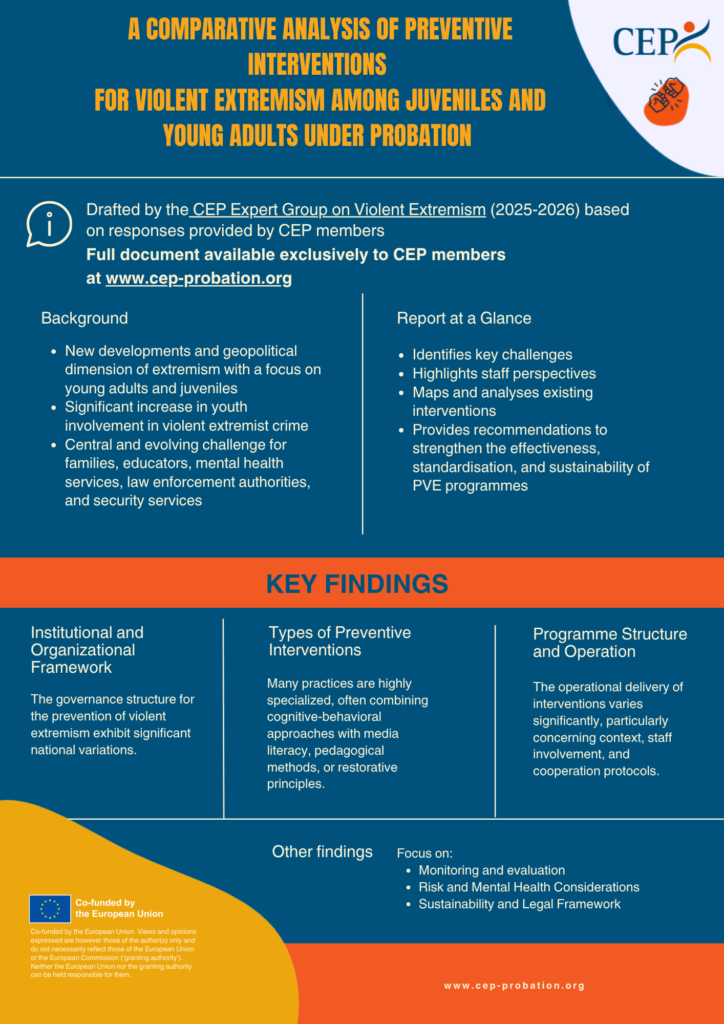
Understanding Youth Radicalisation: What Can Probation Services Do? | New Report from CEP’s Expert Group
27/10/2026
In recent decades, the violent radicalisation of juveniles and young adults has become a pressing concern for policymakers, researchers, practitioners, and communities worldwide. While considerable attention has been devoted to psychological vulnerabilities, socio-economic marginalisation, and community-level influences, the broader context in which violent radicalisation develops is often overlooked. At the same time, the increasing involvement of young people in violent extremist offences highlights the urgent need for effective prevention efforts. Addressing youth radicalisation has become a complex and evolving challenge for families, educators, mental health professionals, law enforcement agencies, probation services, and security authorities.
Recap

Probation in Europe
Reflections on the European Soceity of Criminology Conference 2026 | From Criminological Research to Probation Practice
26/10/2026
In CEP we are fascinated to learn from research across Europe and beyond and help it reach the people who can use it. So, in Warsaw I spent most of my time with the ESC’s Working Group on Community Sanctions and Measures. Against a backdrop of overcrowded prisons and net-widening (ever more people drawn into supervision), three questions kept coming up in the research: how time shapes justice, what we mean by success, and how we define harm.
New

Technology
Registration deadline approaching: Join CEP’s final workshop of 2026 on technology in probation
22/10/2026
📢 Have you registered yet? CEP’s final workshop of 2026 takes place on 24 November in Barcelona, bringing together professionals to explore how technology is being used across probation services in Europe.
The Workshop on Alternatives to Detention and Technologies: Deep Diving into New Trends will look beyond artificial intelligence to examine the different ways technology is shaping probation practice, from staff training to working with clients and collaborating with other criminal justice partners.
Recap

Directors General Meetings
CEP Leadership Excellence Training: strengthening leadership and cooperation across Europe
22/10/2026
The CEP Leadership Excellence Training, held on 20–21 October in Zagreb, Croatia, brought together Directors General and senior probation managers from 11 European countries for a two-day interactive programme focused on leadership, communication, staff development, and international cooperation.
New

CEP
Call for Proposals: Evaluation of CEP Expert Groups
21/10/2026
On behalf of Ms. Jana Špero Kamenjarin, CEP Secretary General, it is my pleasure to invite you to submit a proposal to conduct an evaluation within the CEP work programme.
Recap

Uncategorized
CEP at UNODC: Contributing to the Development of Probation Services Worldwide
19/10/2026
The Confederation of European Probation (CEP) was represented by its Secretary General, Jana Špero Kamenjarin, at the Expert Group Meeting on the Establishment of Probation Services and Probation Practices, organised by the United Nations Office on Drugs and Crime (UNODC) and held at the Vienna International Centre (VIC) from 12 to 14 October 2026.
Subscribe to our bi-monthly email newsletter!
"*" indicates required fields
- Keep up to date with important probation developments and insights.